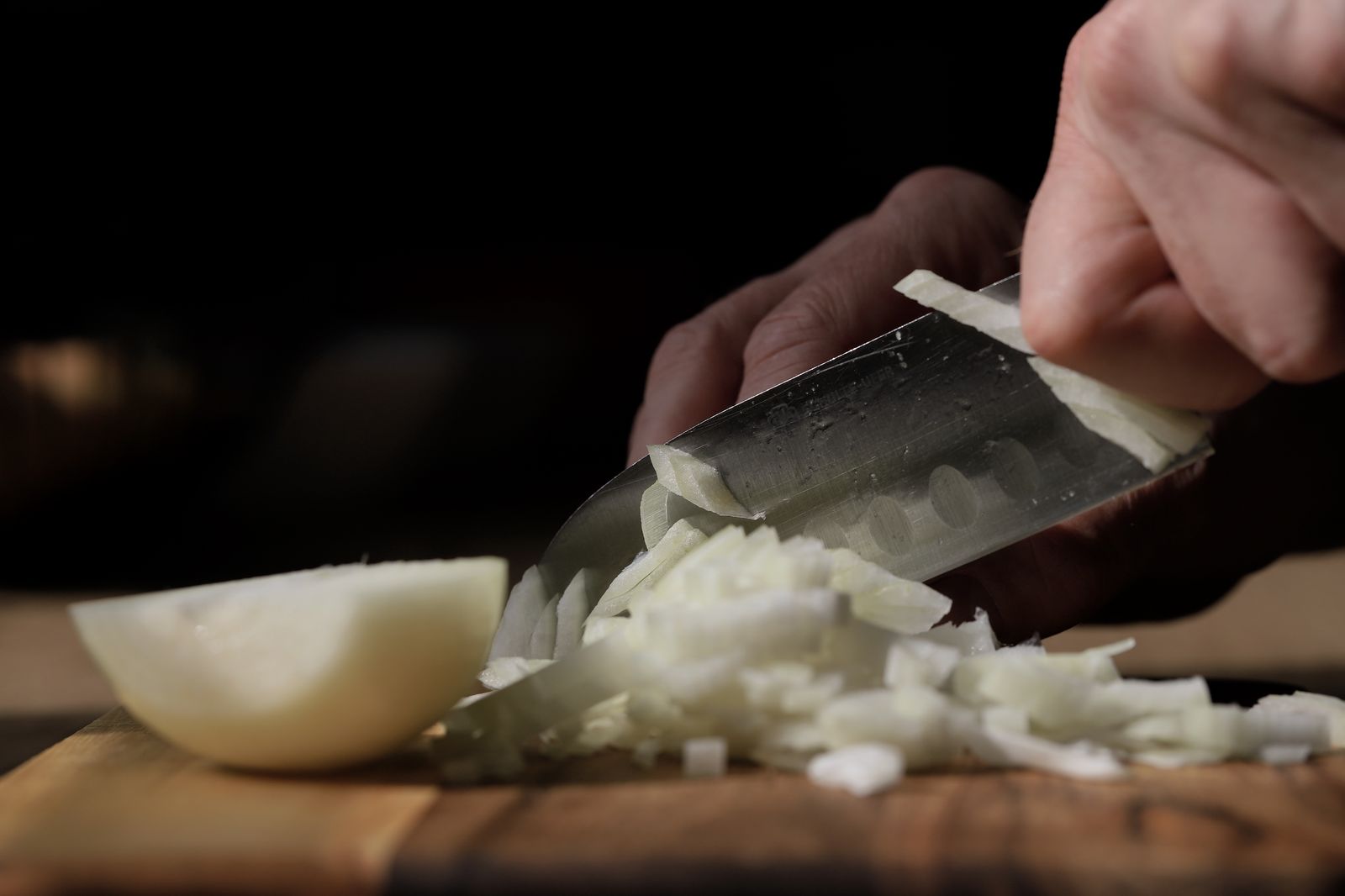
Most people who come to our knife skills class hold a chef’s knife like a hammer, with the whole hand wrapped around the handle and the index finger pointing down the spine. It feels secure, but it gives you very little control, and control is what keeps your fingers safe.
The pinch grip
Slide your hand up until your thumb and the side of your index finger pinch the blade itself, just in front of the handle. The other three fingers wrap the handle loosely. It feels odd for a week, and then it feels like the knife is part of your hand.
With the pinch grip the knife goes where you look. You can feel the edge meet the board, and you stop pressing down so hard.
The claw
Your other hand holds the food, and it is the hand that most often gets cut. Curl the fingertips under so the first knuckles face the blade, and rest the flat of the knife against those knuckles as you cut.
The knuckles become a guide. Move the claw back a little after each slice and the slices stay even without you having to watch every one.
A rocking cut
Keep the tip of the knife on the board and rock the heel up and down while you push the food under it. Let the knife do the work; a sharp edge needs very little force.
Start slowly. Speed comes on its own after a few weeks of dicing onions for dinner, and it comes much faster when the grip is right from the start.
Practise on cheap vegetables
Carrots, celery and onions are perfect practice. Cut a few for a soup or a stock each week, and pay attention to even sizes rather than speed.
If you want a chef to check your grip, our free 30-minute taster on Saturday mornings is exactly that, and you take home a printed practice sheet.