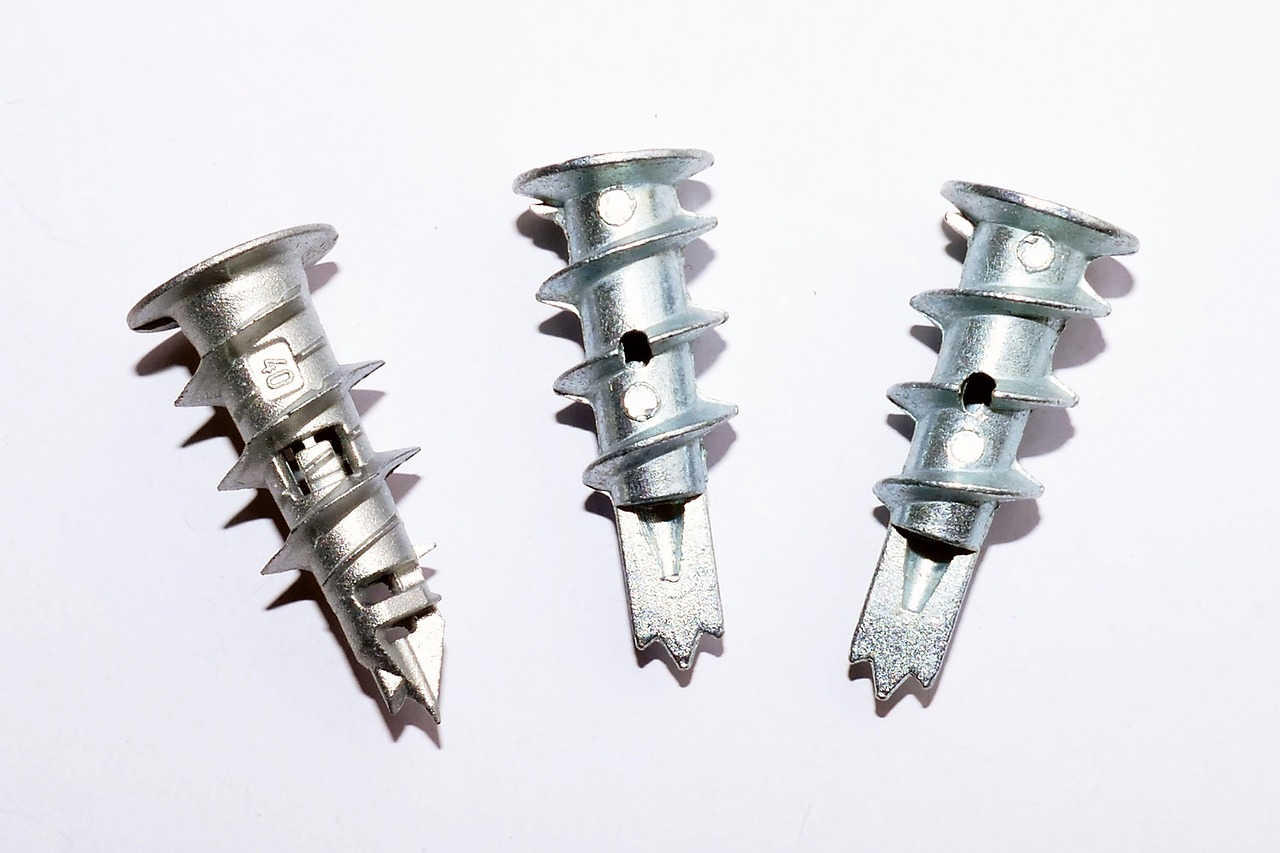
When there is no stud where you need one, an anchor spreads the load across the drywall instead. Choosing the right one is the difference between a shelf that holds for twenty years and one that falls in the night.
Plastic expansion plugs
The plugs that come free in furniture boxes are made for brick and concrete. In drywall they spin and crumble the gypsum. Use them only for very light things, like a small picture, or leave them in the box.
They do have a place outside, though. On a block wall or a stucco-over-block garden wall, a plastic plug in a properly sized masonry hole holds hose reels, house numbers and light planters well.
Self-drilling anchors
These threaded anchors screw straight into drywall with a screwdriver and hold a mirror, a towel bar or a light shelf. They are quick and easy to remove. Look at the rating on the packet and divide it by two for anything that gets pulled on, like a towel bar.
Toggle bolts and strap toggles
For heavier loads, such as a loaded bookshelf or a large mirror, use a toggle. It folds through a hole and opens behind the drywall like a wing, so the load spreads over a wide area. Strap toggles are the easiest to fit and the strongest of the common types.
Even the best toggle depends on the drywall staying in one piece. Anything that moves, such as a TV arm or a grab bar, needs a stud or added blocking.
Our rule of thumb
Pictures and light decor go on self-drilling anchors, shelves on toggles or studs, and anything that people lean on or pull goes into wood. We carry all three on every visit.
When you take something down, the anchor usually stays behind. Self-drilling anchors unscrew cleanly; toggles can be pushed through into the wall cavity. Either way, the hole is a five-minute spackle job before the next coat of paint.