Most people cross the Bolivian Altiplano in three days. We took four, with an extra night in a village at the edge of the salt, and we were glad of every hour of it. At this height, slow is not a style; it is how your body asks to travel.
We booked with a small family-run outfit in Uyuni we will call Ruta Blanca: one jeep, one driver named Efraín, a cook named Lidia and four of us in the back. The price included simple meals, shared rooms and a lot of patience with our questions.
The salt
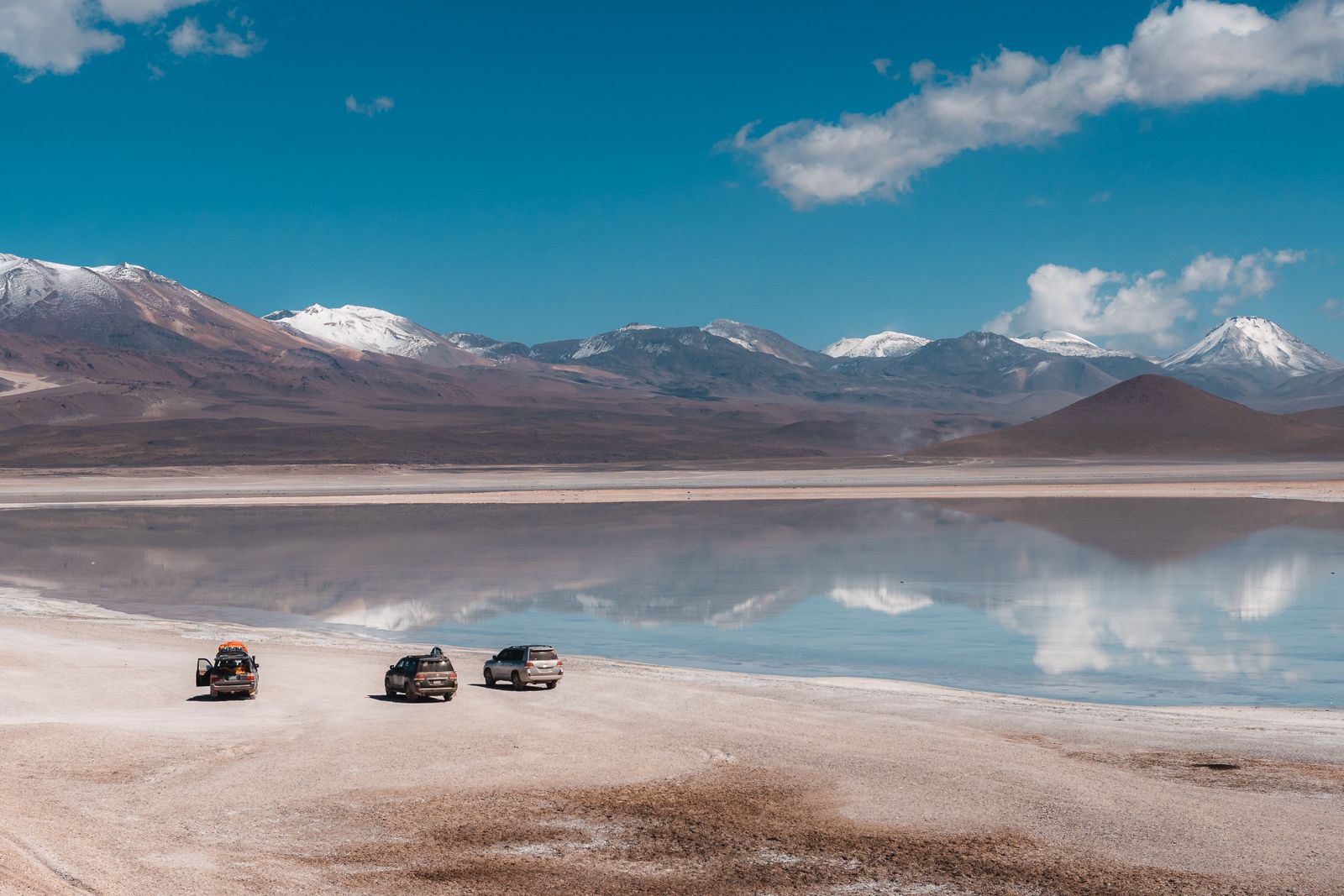
The first day was the Salar itself, a white plain so flat that the horizon disappears. In the dry months it cracks into hexagons; after rain it becomes a mirror. We had a little of both, and spent an hour doing nothing but watching the sky reflected under our boots.
Uyuni to the Chilean border
- Day 1: the Salar de Uyuni and a night in a salt hostel at its edge
- Day 2: a quiet day in the village of San Juan
- Day 3: high lagoons, flamingos and the red Laguna Colorada
- Day 4: the geysers at sunrise, hot springs and the border
Going high
The third night we slept near Laguna Colorada, at about 4,300 metres, and the fourth morning we stood among geysers at 4,850. We had spent a week in La Paz and Sucre first to let our bodies adjust, drank more water than felt reasonable and walked everywhere at half speed. Headaches came anyway and went again.
Before you go high
We are not doctors. Before any trip this high, talk to one about altitude and how your own body handles it, and be ready to turn round or go lower if you feel unwell.
The cold
Nobody warned us properly about the nights. The refugios have no heating, and it was minus fifteen outside. We slept in every layer we owned, inside our sleeping bags, under four blankets. Teo wore his hat for two days straight.
It was worth all of it. We have never seen colours like the lagoons, or a sky that dark and that full of stars.