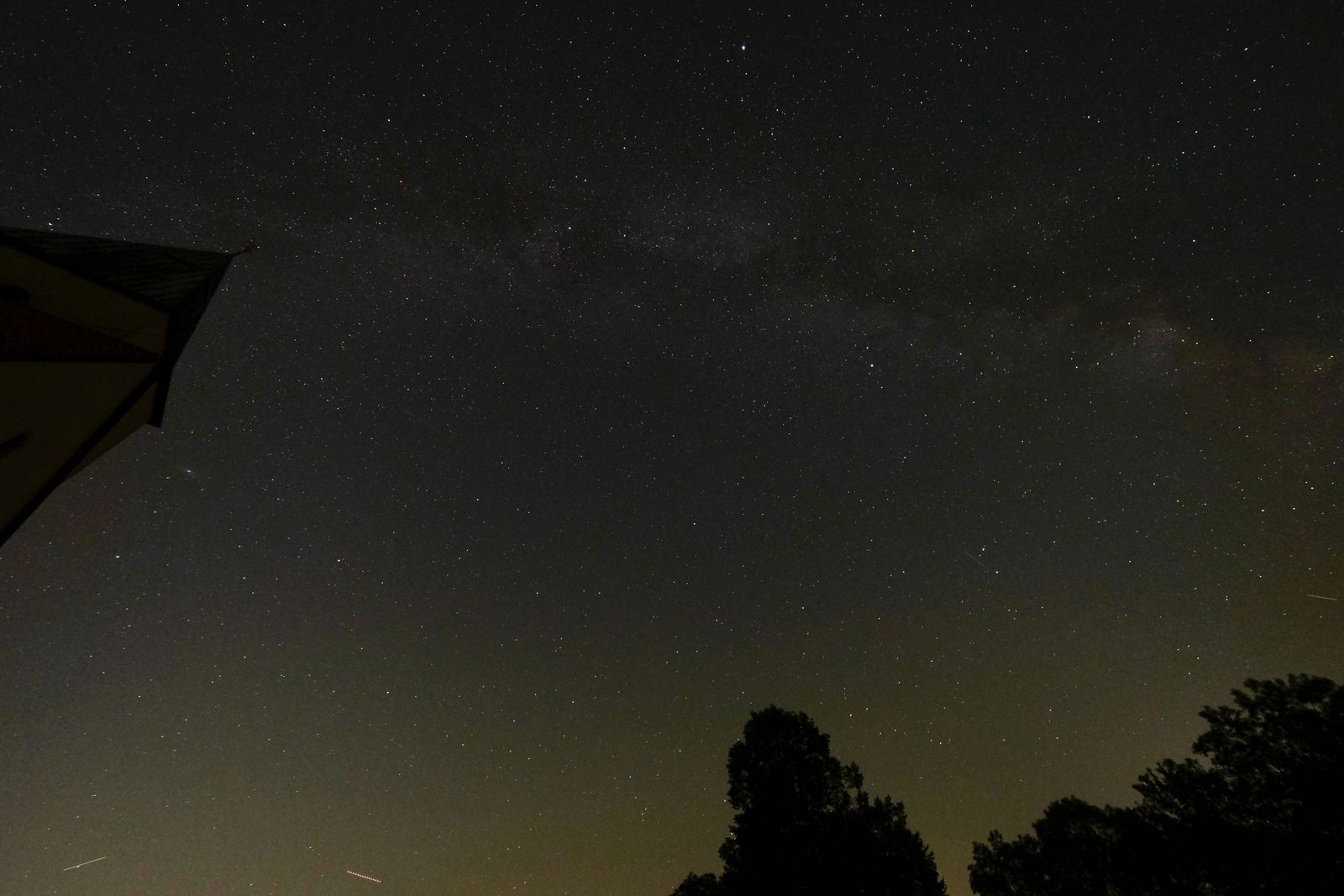
Here is a question that sounds childish and puzzled astronomers for centuries. If the universe goes on and on, filled with stars, then every line of sight should eventually hit a star. The whole sky should blaze as brightly as the surface of the Sun. So why is it dark at night?
The puzzle is often called Olbers’ paradox, after the 19th-century German astronomer Heinrich Olbers, though others had raised it before him. The answer took until the 20th century to settle, and it turned out to say something deep about the universe.
Clue one: light takes time
Light is fast, but not infinitely fast. When you look at a distant galaxy, you see light that left it long ago. The universe has a finite age, about 13.8 billion years, so there is a limit to how far we can see: light from beyond that distance simply has not had time to arrive. We see a finite number of stars, and they do not cover the sky.
Clue two: stars do not last for ever
Stars are born, shine for millions or billions of years and fade. Even in a very old universe, the stars that are shining at any moment are spread out with enormous gaps of empty space between them.
Clue three: stretched light
The universe is expanding. Light that travels across expanding space gets stretched to longer wavelengths, which astronomers call redshift. The oldest light we can detect, released when the young universe first became transparent, has been stretched so much that it now arrives as microwaves.
So in a sense the sky is not dark at all. It glows faintly in every direction, at a temperature of about 2.7 degrees above absolute zero. Our eyes just cannot see that colour.
The numbers
- Age of the universe
- 13.8 bn yrs
- Microwave glow
- 2.7 K
- Speed of light
- 300,000 km/s
A dark night sky is evidence that the universe had a beginning.
Next time you step outside on a clear night, the darkness between the stars is worth a second look. It is one of the simplest observations in science, and one of the most telling.