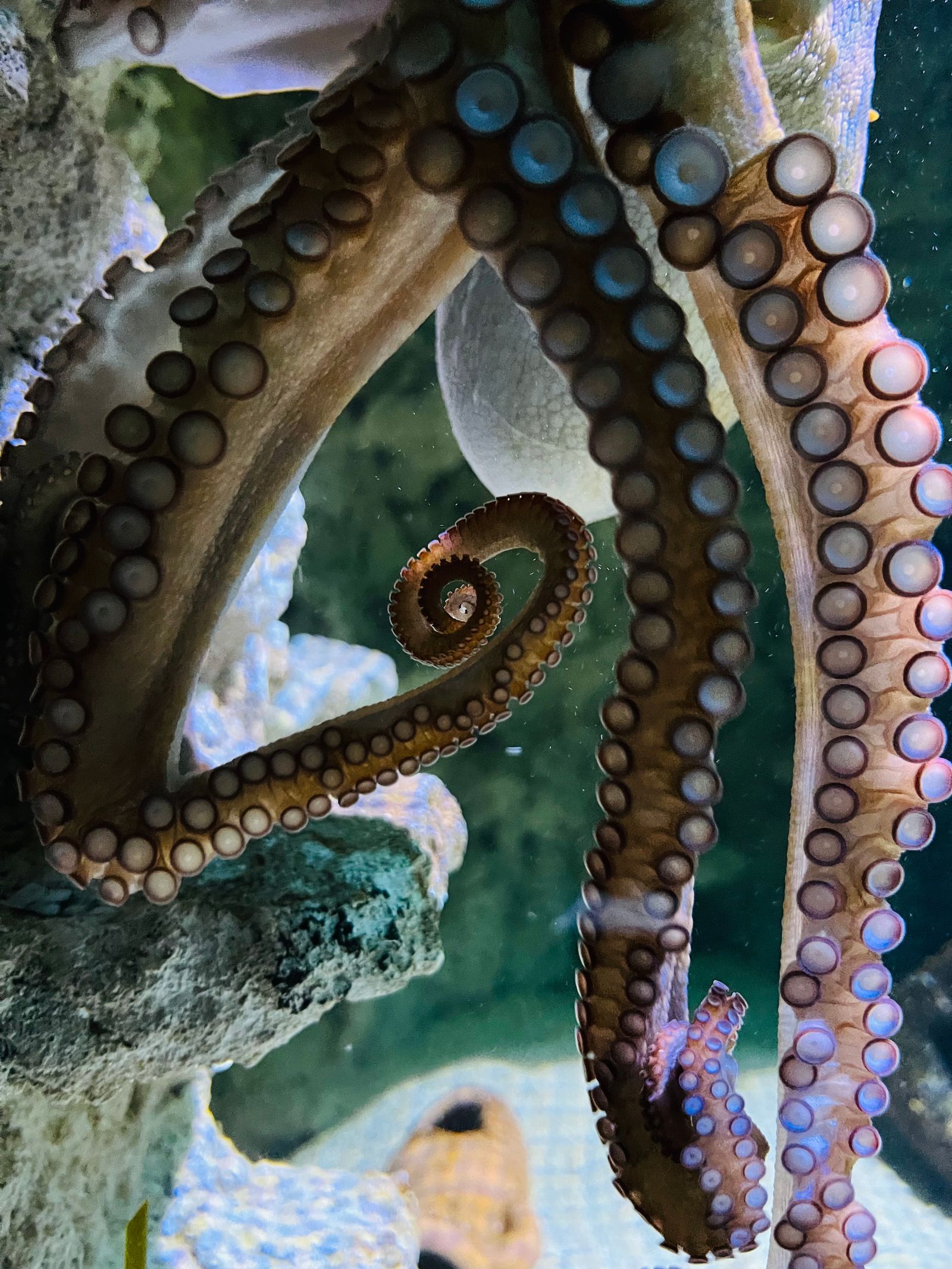
Imagine reaching into a dark cupboard and tasting what you touch. For an octopus, that is ordinary life. Its suckers are packed with sensors that respond to chemicals, so an arm poking into a rock crevice can tell whether there is a crab inside without the octopus ever seeing it.
A brain spread out
An octopus has roughly 500 million neurons, about as many as a dog. But around two-thirds of them are not in its head. They are in its eight arms, arranged in bundles that run along each arm and connect to every sucker.
That arrangement lets each arm handle a lot of work on its own. An arm can search, grip and pass food towards the mouth while the central brain gets a summary rather than every detail.
The numbers
- Neurons in total
- about 500 m
- Share in the arms
- about 2/3
- Hearts
- 3
Touch and taste at once
Each sucker carries sensory cells for touch and for chemicals. Researchers studying these cells have found receptors that respond to compounds found on the surface of prey, which fits what divers and aquarium keepers have long noticed: octopuses explore with their arms first and decide later.
This is sometimes called taste by touch. It is useful in a world of crevices, sand and murky water, where eyes are not much help.
What we know, and what we don’t
- Known: octopus suckers sense chemicals as well as pressure.
- Known: most octopus neurons sit in the arms, not the central brain.
- Still asked: how the arms and the brain share decisions, and how much an arm “decides” by itself.
And the other strange facts
While we are here: octopuses have three hearts, two for the gills and one for the body, and their blood is blue, because it carries oxygen with a copper-based molecule rather than the iron-based one in ours.
They are also a reminder that intelligence can be built in very different ways. An octopus and a human share a distant ancestor more than half a billion years ago, a simple creature with no brain to speak of. Everything clever about both of us evolved separately since then.