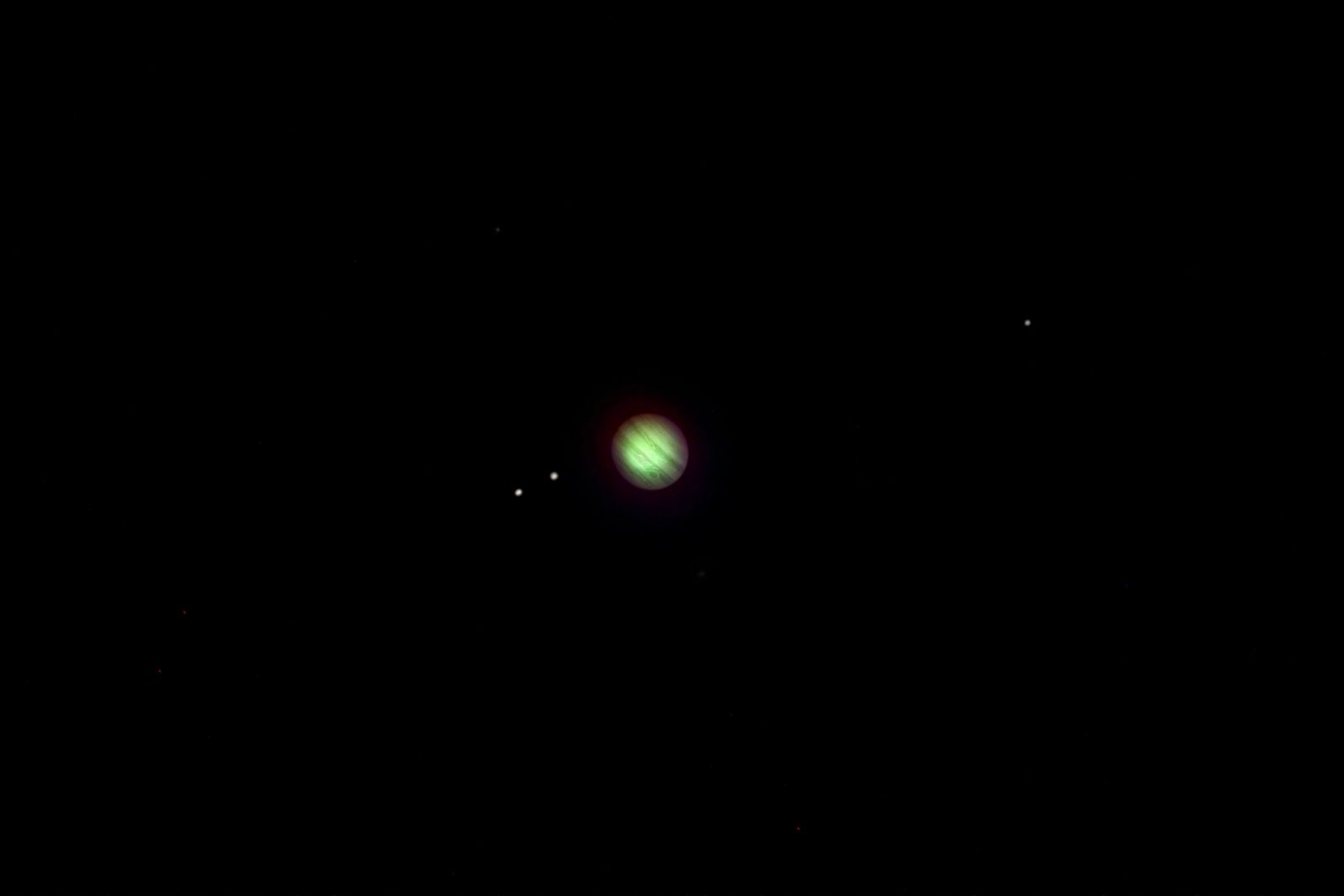
Jupiter has about 318 times the mass of Earth. Nobody has been there, and there is no scale big enough. So how do we know?
The short answer: by watching things fall around it. A moon in orbit is falling towards its planet all the time, while moving sideways fast enough to keep missing. How fast it has to go depends on how heavy the planet is.
The rule behind it
In the early 1600s, Johannes Kepler noticed a pattern in planetary orbits: the time an orbit takes is linked to its size. Later in the same century, Isaac Newton explained why, with his law of gravity, and turned the pattern into a formula that includes the mass of the central body.
Weighing with a moon
- Measure how far the moon is from the planet.
- Time how long one orbit takes.
- Put both into Newton’s version of Kepler’s rule, together with the gravitational constant.
- Out comes the combined mass of the planet and moon, which is almost all planet.
The missing number
There is a catch. Newton’s formula needs a number called the gravitational constant, which sets how strong gravity is. It is tiny and hard to measure. Henry Cavendish measured it in 1798 with a delicate experiment: lead balls on a twisting wire in a shed, slowly pulled towards larger lead balls. Once that number was known, Earth itself could be weighed, and then every planet with a moon.
No moon? Send a spacecraft
Mercury and Venus have no moons. Their masses were pinned down by spacecraft flying past them. As a probe falls through a planet’s gravity, its speed changes slightly, and radio signals from it shift in pitch. Tracking that shift tells mission teams how hard the planet pulled.
Planets around other stars
For planets orbiting distant stars, astronomers reverse the trick. A planet tugs its star in a small circle, so the star wobbles towards us and away. That wobble shifts the colour of its light very slightly. From the size and timing of the wobble, they can work out a minimum mass for the planet.
The numbers
- Jupiter
- 318 Earths
- Saturn
- 95 Earths
- Earth
- 5.97 × 10²⁴ kg
It is one of the quiet triumphs of physics: an idea about falling apples, a shed full of lead balls and patient timing, and we can weigh worlds.