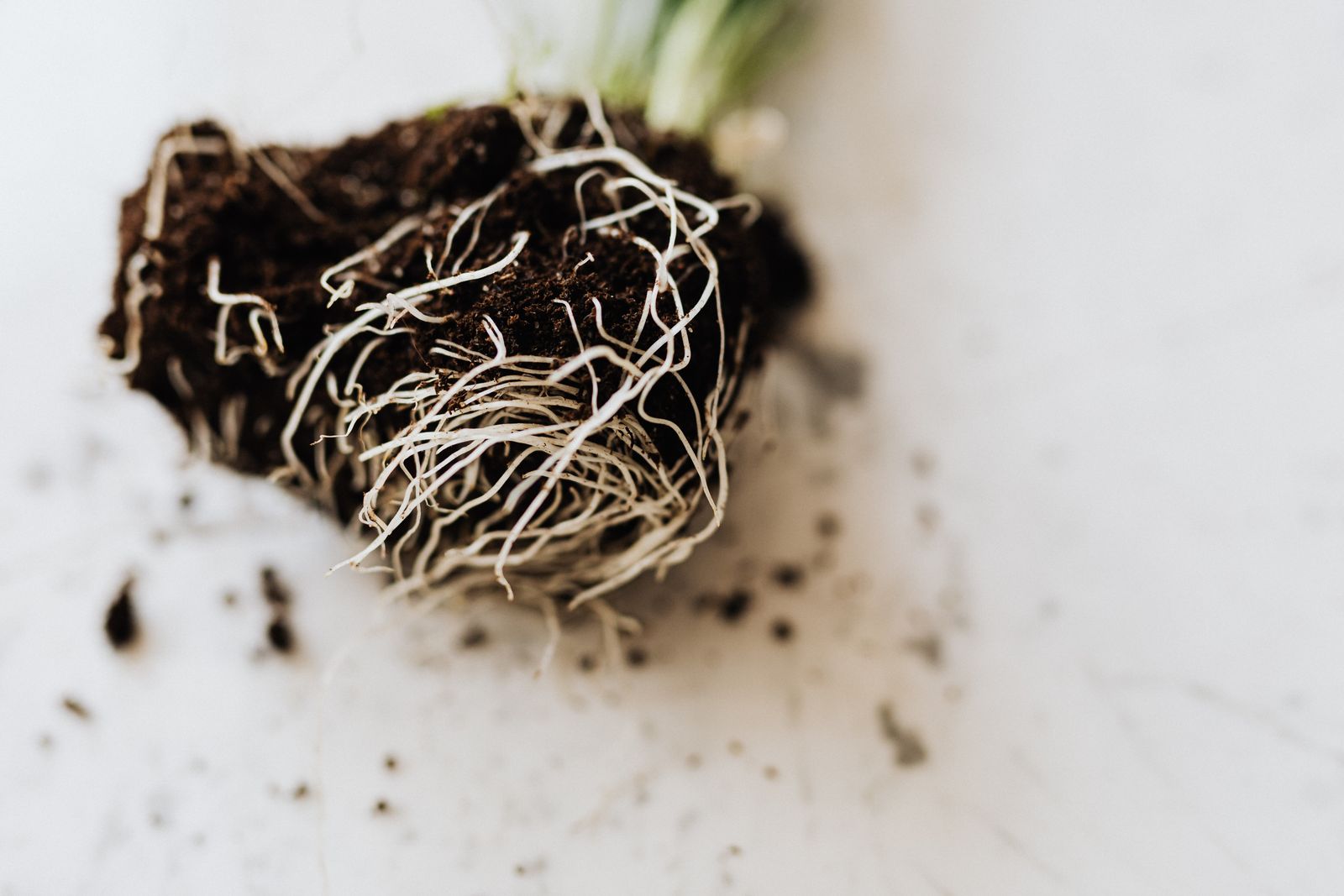
Drop a bean into the soil in any position and it will sort itself out. The root will bend until it points down, and the shoot will bend until it points up. The plant has no eyes, no inner ear and no brain. So how does it know?
A spirit level made of starch
At the very tip of a root sits a small cap of cells. Inside some of them are dense grains packed with starch. Because they are heavier than the rest of the cell, they sink to whichever side is lowest, like sand settling in a jar.
When the root is tipped sideways, the grains slide to a new side of the cell. The cell senses where they have settled and passes on a signal.
From tilt to turn
- Tilt: the root is no longer pointing down.
- Settle: starch grains in the root cap sink to the new lower side.
- Signal: the cells move a growth hormone called auxin towards the lower side of the root.
- Bend: in roots, extra auxin slows growth, so the upper side grows faster and the root curves downward.
Shoots use a related system with the opposite result. More auxin on the lower side of a shoot speeds growth there, so the shoot curves up.
An old question
Charles Darwin and his son Francis spent years experimenting with growing roots and shoots, and in 1880 they published a book on how plants move. They noticed that the root tip seemed to be in charge: remove it and the root lost its sense of direction. They did not know about starch grains or auxin, but they had found the right place to look.
The root cap is a plant’s sense of balance.
What we know, and what we don’t
- Known: roots sense gravity mainly in the root cap.
- Known: auxin moving to one side drives the bend.
- Still asked: exactly how cells feel the starch grains settle; there are several candidate mechanisms.
And in space?
Plants grown in orbit, where there is no clear up or down, still grow, but their roots wander. They follow water and light instead, and sometimes curl in loops. It is a neat confirmation that, on Earth, gravity is doing a great deal of the steering.